
This post is sponsored by Terracon.
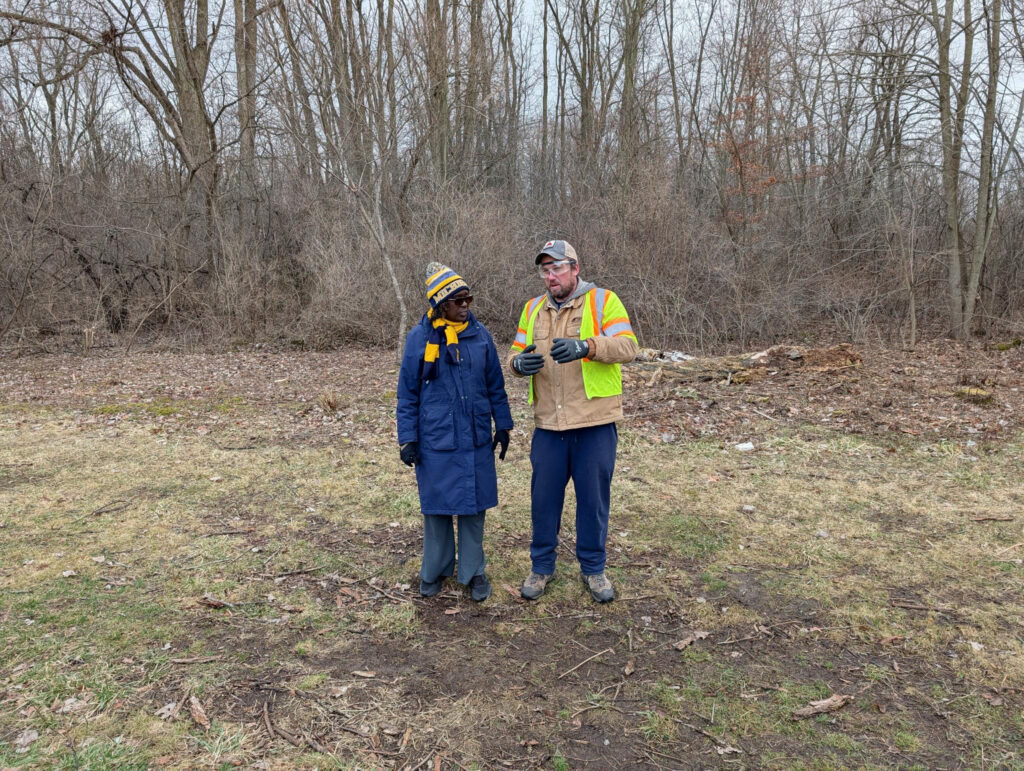 Dr. Debby Mitchell Covington, board member of the African American Cultural and Historical Museum of Washtenaw County, and Alexander C. Corkum II, Ph.D., RPA # 18158, Terracon project geophysicist, on-site at Woodlawn Cemetery in Ypsilanti Township.
For decades, much of Woodlawn Cemetery was hard to find. Brush covered the ground. Markers disappeared beneath soil or vegetation. Records that could have helped families locate loved ones had been lost to fire. At this historic African American cemetery in Ypsilanti Township, Michigan, descendants, neighbors and volunteers are working to reclaim a place that has gone unmaintained since 1965. Established in 1946, Woodlawn holds the stories of families, veterans and community leaders. The restoration effort is not only about documenting graves; it is about restoring access, honoring memory and helping families reconnect with a place that still carries meaning across generations.
Terracon’s volunteer role is one piece of a larger community-led effort. Local organizations, descendants, residents and other volunteers have been clearing vegetation, listening to families, preserving stories and considering what Woodlawn should become in the years ahead. By contributing specialized expertise alongside that work, Terracon is helping answer questions that matter deeply to families and to the community: Who is buried here? Where are their resting places? How can this cemetery be protected and cared for?
Technology is helping the team learn more without disturbing the ground. Terracon’s use of advanced, noninvasive tools, including high-density ground-penetrating radar, drone-based photogrammetry, real-time kinematic global navigation satellite system mapping and Lidar, is helping identify unmarked graves, buried markers, surface depressions and other cemetery features with care. Ground-penetrating radar has also helped broaden understanding of the cemetery’s true extent, shifting early estimates from fewer than 200 graves to approximately 1,000. For cultural resources practitioners, the work shows how subsurface, topographic and orthorectified imagery can reduce uncertainty, guide interpretation and support defensible avoidance recommendations in a sensitive burial context.
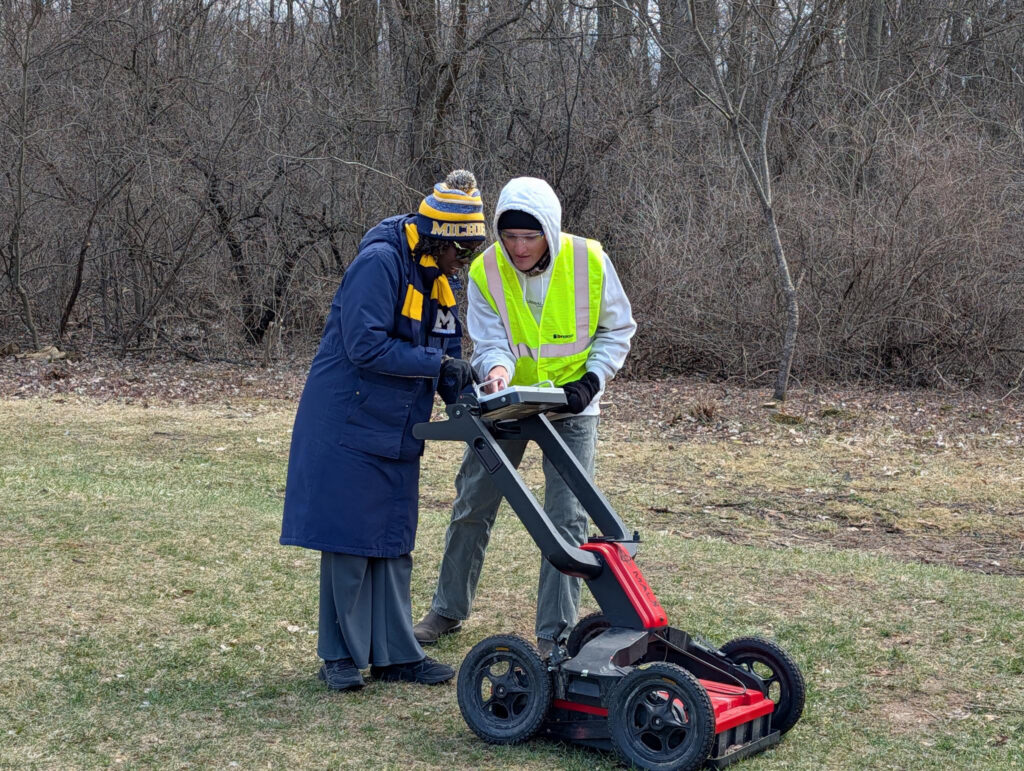 Dr. Covington and Tucker Terrell, Terracon field geophysicist, with a Mala Easy Locator Core Wide Range (Mala EL Core WR). The dual-frequency GPR collects 160 MHz and 670 MHz data simultaneously.
Woodlawn is also giving Terracon professionals a hands-on way to learn through service. The site has become a training ground for geophysical and archaeological staff, helping build skills that can support future cemetery investigations and other culturally sensitive projects. Additional testing with multiple ground-penetrating radar systems, electromagnetic induction, magnetometry, twin-probe earth resistance, electrical resistivity tomography and drone-based Lidar will help practitioners compare methods, understand site constraints and refine workflows for documenting burial landscapes where disturbance must be avoided.
For Terracon, the work at Woodlawn is a clear example of how technical expertise can serve a bigger purpose. The same tools used to map and interpret complex sites are helping bring long-hidden information back to families and to the community. The broader effort also includes pursuing listing in
the National Register of Historic Places and designation as a local historic district, steps that would help strengthen protections for the cemetery well into the future. Together, the work is helping document a historic burial ground, support descendants and make sure Woodlawn’s stories are not lost again.
About Terracon
Terracon is an employee-owned, multidiscipline consulting firm comprised of more than 8,000 curious minds focused on solving engineering and technical challenges from more than 200 locations nationwide. Explore with us by visiting terracon.com.