
By the 1940s, New York’s Pennsylvania Station was processing more than 100 million passengers each year. More than 900 trains a day brought commuters, tourists, soldiers and many others from all parts of the country to Seventh Avenue and 33d Street. Long before there was an Air Force One, U.S. Presidents would arrive in Manhattan via the POTUS Special on the Station’s tracks 11 and 12.
When all those people passed beneath the Station’s Beaux Arts façade, they were greeted by two marble women, “Day” and “Night,” sculpted by Adolph Weinman, who flanked the clocks on each building face. They were just one sign of the care and detail that went into the McKim, Mead and White-designed cathedral to modern transportation.
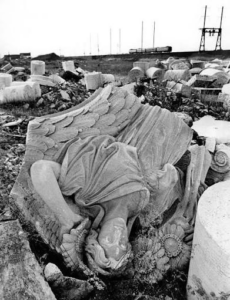
If you’re reading ACRASphere, you likely know the rest of the story: how the Station was demolished in 1963, despite public protest, paving the way for a far less inspiring sports arena (and occasional wedding venue) and bland office towers. “Day” and “Night” were unceremoniously dumped in a New Jersey landfill, where New York Times photographer Eddie Hausner captured them in their misery.
That destruction, more than anything else, is credited with spurring Congress to pass the National Historic Preservation Act (NHPA) in 1966, making certain that such a “monumental act of vandalism” would never again happen without the public having a say.
The NHPA begat the Advisory Council on Historic Preservation, SHPOs, and (years later) THPOs, and, of course, Section 106, which led to the formation of the 800 regulations that put Section 106 into practice.
Over the years, those regulations have been tweaked, debated and interpreted. And while nobody in their right mind would say the regs are perfect, the consultative process and approach to effects on historic properties they provide for have created an environment where the wanton destruction of historic spaces like Penn Station is far less likely to happen.
But if the current Council gets its way, that all could change.
On Friday, the Council announced that its members had voted to advance a massive overhaul of the regulations, which now go to the White House Office of Management and Budget for review before a 30-day comment period opens. The timing of these steps is not certain, but what is clear is that the preservation sector is mobilizing fast to block the most radical rewrite of the rules in their history.
As ACRA’s assessment of the proposal published Friday concludes, the revised regulations, crafted in secret and rushed to approval, need to be scrapped.
All three ex-oficio members of the Council – the National Trust for Historic Preservation, the National Conference of State Historic Preservation Officers, and the National Association of Tribal Historic Preservation Officers – have expressed their opposition to the proposal. Democrats on the Senate Energy and Natural Resources Committee have spoken out against the plan. And ACRA and its preservation partners are crafting strategies to stop the changes.
But the proposed changes are not simply a threat to preservation. By reducing public consultation and engagement, they are likely to snarl infrastructure projects in more litigation and confusion – the exact opposite of what the Council claims the revisions are meant to do.
Stay tuned for more updates on the changes. And if you are an ACRA member, join us for our Hot Topic on the proposal this Wednesday.
Just as the preservation movement pushed Washington to enact the NHPA sixty years ago, our collective efforts will ensure that the Section 106 process continues to strike a balance between preservation and development.
Congress Heads for the Exits as Midterms Loom
While the 800 regulations are the focus for the preservation community these days, Congress is busy trying to do the people’s business – with limited success.
The House departed Washington late last week for its August recess after passing a continuing resolution that would keep the federal government running after October 1. While the move towards avoiding a government shutdown is welcome, it underlines how far behind Congress is in conducting its regular business.
To date, the House has passed only three of the 12 annual appropriations bills that find discretionary spending for the upcoming fiscal year, although the House Appropriations Committee has approved all 12. That’s better than the Senate, where its Appropriations Committee has not approved any bills.
Part of the holdup is that the two chambers cannot agree on overall spending levels. Their work also is complicated by the Trump administration’s push for Congressional Republicans to pass more defense spending via a “reconciliation” bill that Senate Democrats could not filibuster.
Last week, the House adopted on a party-line vote a budget framework which would allow the Hill to advance a filibuster-proof bill that would include $95 billion for Iran war defense funding, farm aid, and elements of President Trump’s election reform bill. However, it’s not clear Senate Republicans have the votes to pass it. For one thing, Sen. Mitch McConnell’s (R-KY) extended absence deprives them of a vote they would desperately need. Some Senate Republicans also are opposed to the election reform provisions. With the Senate expected to head home for recess soon, the big decisions will have to wait until the fall.
Of course, the fall Congressional session will be truncated by lawmakers’ need to campaign. When members of Congress face the choice between staying in D.C. to get things done or head home to fight for their seats, history shows that legislating usually loses.